

Sustaining the South Side
A chat with Dutchtown South Community Corporation's Karisa Gilman-Hernandez.

I’m writing this on No Kings Day, a chance for people to show up in their local communities and tell the world what they stand for: democracy, human rights, and caring for the vulnerable. So it’s only fitting to spend time today sharing a profile of Karisa Gilman-Hernandez, who got her start in community organizing and is now the executive director of Dutchtown South Community Corporation (DSCC), a nonprofit that works to activate South St. Louis’s vision for equitable, thriving neighborhoods. After all, there are many ways for us to show up for each other, including making sure that people have places to live, as DSCC does.
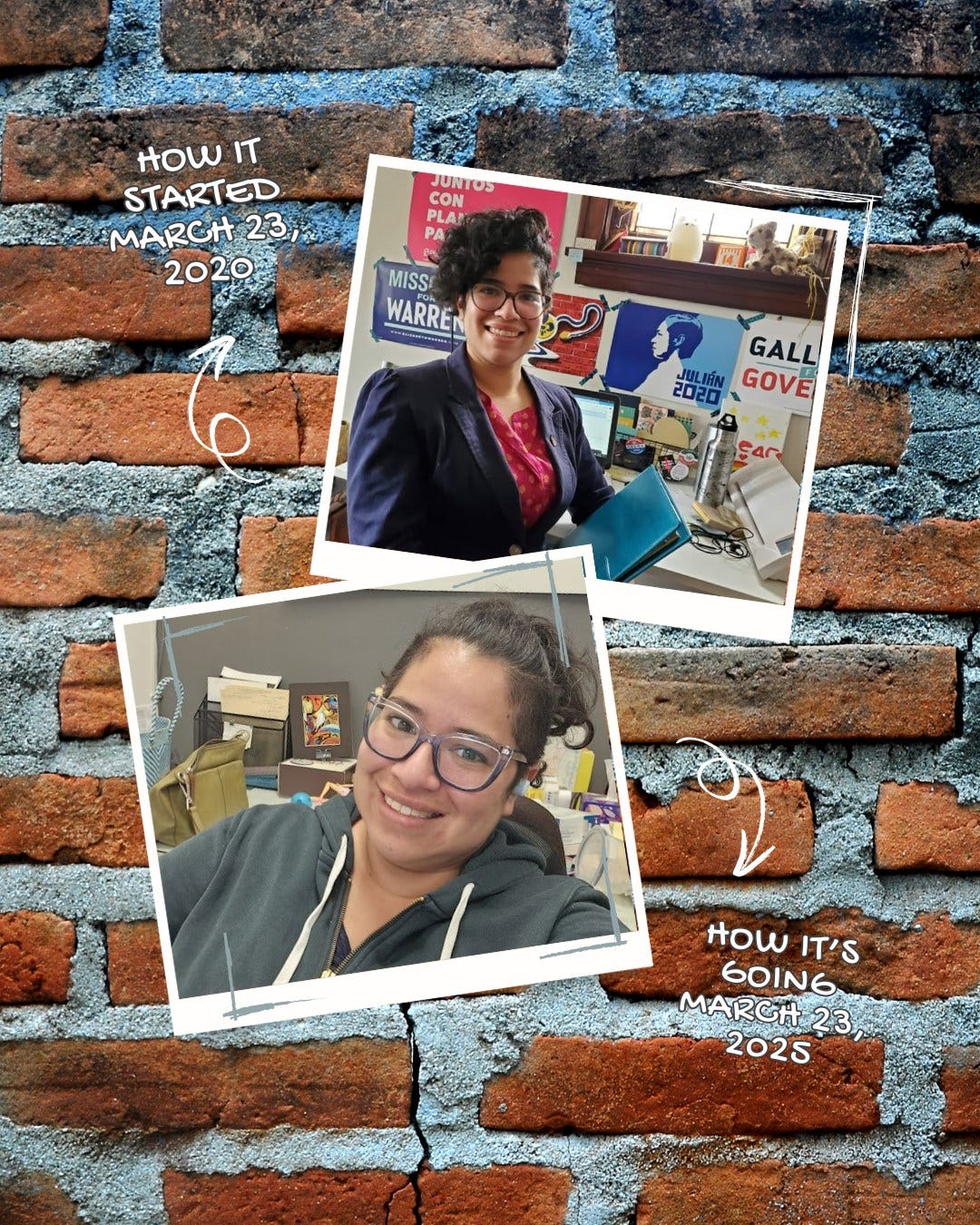
Back in 2016, Karisa volunteered for a local politician, knocking on doors and getting out the vote. She thought of this involvement more like a hobby, but when Donald Trump won the presidency that fall, “It just felt like the world was going to end,” she says. “So I just threw myself into every organization I believed in.”
Fast forward to 2020. She felt a calling to either work for a nonprofit or for the city, and encountered Dutchtown South Community Corporation at a Hispanic Chamber of Commerce job fair. They were hiring for a community empowerment organizer; Karisa saw that and thought, “Those are all words I love.”
She got the job, and started as the COVID lockdown began. That meant her first weeks were spent calling residents of the neighborhoods served by DSCC—Dutchtown, Gravois Park, Mount Pleasant, and Marine Villa—to see how they were doing. In a Facebook post celebrating her sixth anniversary at DSCC, she noted, “There was no guide for community organizing during a global pandemic, but I was surrounded by thoughtful, committed people who stepped up to meet the moment.”
Karisa has since gone from being the community empowerment organizer to the director of DSCC, and the organization itself has moved away from an organizing model into focusing more specifically on housing (they maintain some of the most deeply affordable apartments in Dutchtown). What has she learned about housing in that time? “The more I learn, the less I know about housing,” she says, but “it’s a subject that I love talking about. I like digging into different theories and different practices. I like learning about different projects that have been done in other cities or even within St. Louis in the past.”
As an example, Karisa cites the city zoning code, ‘Which was designed to clear cut large swaths of St. Louis. They wanted a reason to start tearing down buildings…it was [designed] to take our neighborhoods away.” (The city is now going through a Zoning Upgrade process they are calling the ZOUP, if folks reading this want to help rewrite the script.)
“But the big thing I’ve learned through the years here when it comes to affordable housing,” Karisa notes, “is that when it’s completely reliant on, and it often is, subsidies that have very specific strings attached to them, like government subsidies, it means that when those subsidies are over and those strings are done, either we have lost those affordable units because they now need to be making enough money to cover their expenses, or we are looking at resubsidizing them through a LIHTC [Low Income Housing Tax Credit] project.
“That just creates a wheel constantly turning. And so St. Louis doesn’t currently have a mechanism for quality, naturally occurring affordable housing. That’s one of the things that we talk a lot about here at the office: what does it look like to create affordable housing in perpetuity, and not just the first ten years the building exists.”
The approach DSCC is taking for this problem is a Mixed Income Neighborhood Trust, or MINT. “The concept behind it is that it's in a perpetual purpose trust. Because of that, the units themselves will be governed mostly by the tenants who live there, which is important to me because renters are often times at the whim of a landlord. I say this as a landlord! My tenants, I do my best by them, but at the end of the day, I control their access to housing. That’s not an equal footing relationship that we have. Trying to create that equal footing is important.
“That is an important aspect of this project,” Karisa continues, “but it also would have half the units to be market rate for the area, and then the other half would be deeply affordable”—which means they would be primarily for people earning 30% of area median income or less.
“The market rate units would subsidize the affordable units,” Karisa says, which is why the name “Mixed Income Neighborhood Trust.” “How it is mathed out is that the units would have enough money to be well cared for, to have the needed major repairs done, so the affordable units and the market units would be indistinguishable from each other. And all of that would lead to these units being an affordable unit within the footprint for as long as the project can sustain itself.”
The current push at DSCC is to find philanthropic support to get the MINT up and running, so drop Karisa a line if you have any ties to a family foundation or the like!